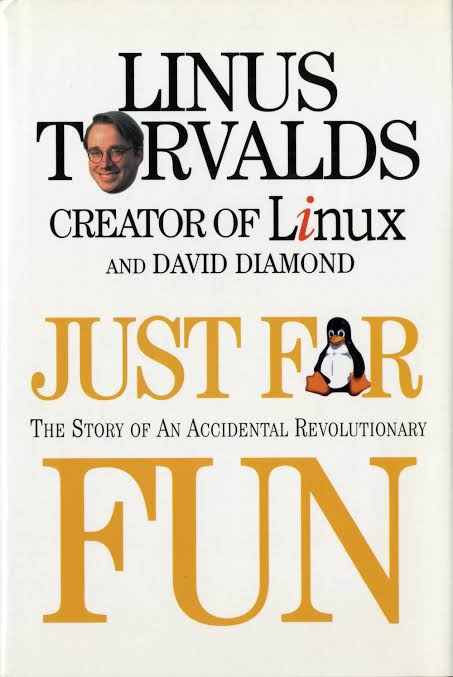
The First Proposition: A Theory of Everything
The journey begins with a bold, almost flippant, assertion. Torvalds proposes a "theory of everything" for human motivation: a three-stage evolution from survival to social order and finally to entertainment. This isn't an academic treatise but the foundational philosophy of a man who built an empire because he was bored. He needed a project - he's said as much himself - and without one, enthusiasm dies. Linux happened because he needed something to build.
This framework serves as both lens and justification for everything that follows. It's the operating system for understanding Torvalds's worldview, one where monumental achievement emerges not from grand ambition but from playful curiosity. The operating system that runs the world began as a distraction.
⚙️ Simple Things, Complex Systems
The creation of Linux is the book's core drama. In 1991, as a student at the University of Helsinki, Torvalds was dissatisfied with the educational MINIX operating system. But more important than the dissatisfaction was the textbook that changed his life: Operating Systems: Design and Implementation by Andrew Tanenbaum. He's spoken about how certain books find you at the right moment. This was his.
The Beauty of Simplicity
What Tanenbaum's book taught him wasn't just how operating systems work. It was that you can build infinite complexity from the interaction of simple components. This insight became the architectural philosophy of Linux. Not grand design from above, but small pieces, well made, interacting in predictable ways. He's argued that simplifying something easy actually takes more skill than making it complicated. Good taste in engineering means knowing what to leave out.
This was a man who could code in assembly, who had built tools and games and clones. He had the intimate OS knowledge. What he needed was a project. The project became Linux.
The Unreasonable Man
When Tanenbaum, the established academic authority, famously critiqued Linux's monolithic design as a step backward into the 1970s, Torvalds did not yield. He defended his architectural vision, arguing that the simplicity of a monolithic kernel was superior to the complex communication overhead of microkernels. He's noted that holding a strong opinion requires excluding other options, and that process inevitably makes you unreasonable in someone's eyes. The debate became legend, but the code kept working.
The name "Linux" itself was an accident. He intended to call it "Freax" (a combination of "free," "freak," and the letter X). The FTP server administrator named the directory "linux" instead. The project, born from personal need and curiosity, was released onto the nascent Internet, inviting others to look, to tinker, and to build upon it. He didn't name the revolution. He just started it.
🏛️ Letting Everybody Play
Torvalds's decision to release Linux under the GNU General Public License (GPL) was pivotal. But the book frames this not as high ideology but as practical wisdom. Open source, in his view, is simply about letting everyone participate. The more players, the better the game.
The Playground Rules
He's been clear that business shouldn't be excluded from open source, given that it drives so much of society's technological progress. The only requirement is that companies play by the same rules as everyone else. The GPL isn't anti-commercial; it's pro-quality. It creates a game where everyone can participate, but nobody gets to take the ball home. For him, it was obvious that this model produced better technology than proprietary development ever could. The way to survive and flourish, he argues, is simply to make the best damn product you can. Not the most protected. Not the most locked-down. The best.
Against Unnecessary Rules
This philosophy extends beyond software. He's expressed deep skepticism toward unnecessary rules imposed by society. The GPL is a rule, yes, but it's a minimal one - designed to enable rather than restrict. It creates the conditions for play, then gets out of the way. That's the difference between a framework and a cage.
👑 The Laziest Benevolent Dictator
The book reveals the paradox of his leadership. He's called a "benevolent dictator" but his management style is one of inertia. He tries to manage by not making decisions and letting things occur naturally. His famous mantra, "Talk is cheap. Show me the code," is the ultimate filter. Rhetoric dies; code lives.
Not Here for Suggestions
He's pushed back on the myth that open source means being more accessible or more open to suggestions. That's never been the point. He's not open to opinions. He's open to contributions. There's a difference, and that difference is the entire structure of Linux development. A thousand people can have ideas. The one who submits working code wins.
The Sleep Test
Perhaps the most revealing passage concerns his relationship to the work. He's noted that neither Transmeta nor Linux ever got in the way of a good night's sleep. You might lose a few productive daytime hours if you sleep, but those hours away leave you alert, your brain functioning properly when you return. The man who runs the world's most critical infrastructure doesn't treat it like a crisis. He treats it like a project. Something he does. Not something that consumes him.
Self-Knowledge
He's been characteristically blunt about his own personality. He's admitted to being difficult, to having been always an asshole by his own description. And he's confessed to being a lazy person who likes getting credit for things other people actually do. The honesty is disarming. He knows exactly who he is, and he's structured his life and his project to accommodate that person rather than fight it. The meritocracy isn't a moral stance. It's an efficiency. Lazy people need good filters.
📞 Bonus: Strong Opinions
The book is peppered with the kind of random, deeply held convictions that make spending time with a brilliant mind worthwhile. His declaration that voicemail is evil arrives without elaboration. None is needed. It's simply true, and he knows it. These moments reveal the man behind the kernel - someone who applies the same stubborn certainty to both operating systems and user interfaces, and somehow is usually right about both.
🔥 The Critique: Shadows of the Idols
A truly critical analysis must turn this lens upon Torvalds and the book itself, revealing its flaws and contradictions.
The Ghost of the Ghostwriter
The narrative voice is co-written with journalist David Diamond. While this makes the story accessible, it inevitably filters Torvalds's raw, notoriously abrasive personality (evident in his famous mailing list tirades) through a more polished, journalistic lens. Is the "fun-loving geek" persona the whole truth? The man who calls himself an asshole probably has edges this book smooths over. The switch between voices is sometimes jarring, and Diamond's sections lack the same authenticity.
The Unexamined Life of Privilege
The story is one of a brilliant mind meeting perfect historical circumstance (the rise of the PC, the Internet). It can unintentionally gloss over the sheer privilege of having the time, education, and resources to spend months programming "just for fun" while others labor for survival - the first stage of his own theory. The framework he proposes applies to everyone, but not everyone gets to skip to stage three.
A Snapshot in Time
Published in 2001, the book is a product of its era. It captures the dawn of open source's commercial acceptance but cannot address the later, more complex debates about corporate influence, ethical licensing, and the challenges of maintaining a massive, critical project in the 21st century. The Linux of 2001 and the Linux of today are different animals, and this book only knows the former. Reading it now feels like opening a time capsule - fascinating, but dated. Nokia is still the biggest thing in phones. Palm Pilots are the future. And yet, some of his predictions about Linux's ubiquity were eerily accurate.
The Style and Its Gaps
Some readers find the narrative can feel slow or repetitive in places. Its focus is squarely on the creation and philosophy of Linux, offering only glimpses into his personal life, such as his marriage to six-time Finnish national karate champion Tove Monni. The man has a life outside code. The book acknowledges this without exploring it. The final section on his fame and commercial Linux feels like filler compared to the energy of the early chapters.
The Git-Shaped Hole
This book predates Git, the other world-changing creation from Torvalds. Reading it now, you can't help but wonder what in his personality led to something so elegantly functional yet notoriously complex. The man who values simplicity above all gave us something that still makes developers swear. The answer probably lies somewhere in the same stubborn practicality, but you'll have to look elsewhere to find it.
🧭 Why You Should Read It
Read this book not as a perfect technical manual or a flawless autobiography, but as a primary source document of a seismic shift in human collaboration. It is the origin story of a system that now powers three-quarters of the cloud, every top supercomputer, and billions of Android devices. The numbers are staggering, but the story remains personal.
It offers a direct window into the mind of an engineer who, through a combination of profound skill, stubbornness, and a radical commitment to openness, helped redefine how we build the digital world. He didn't set out to change anything. He set out to have fun. The revolution was just along for the ride.
If you're deep in tech culture, the central philosophy might resonate beyond the obvious: that doing things for their own sake, because they're interesting, because they're fun - that's enough. In an era where every line of code is evaluated by career potential or exit strategy, that's almost radical.
Final Verdict
8/10 - A foundational and philosophically provocative text from the heart of the digital revolution, whose insights outweigh its stylistic and temporal limitations. It is, as promised, a story of survival, social order, and entertainment. And voicemail remains evil.