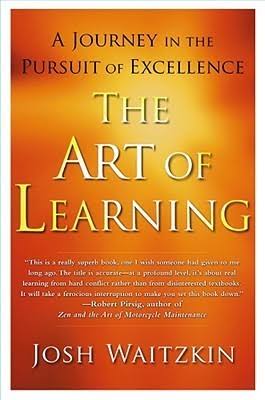
First Contact
I came to this book knowing nothing about Josh Waitzkin. No context. No awareness of the chess prodigy story or the film based on his childhood. Just the title and the promise: a guide to learning from someone who had clearly learned something worth sharing.
That blank slate turned out to be an advantage. I read it cold, without expectations, and let the book build its own case chapter by chapter. By the end, I understood why people talk about it the way they do.
What the Book Is
The Art of Learning is part memoir, part philosophy, part performance psychology. Waitzkin walks through his journey from chess champion to martial arts world champion, drawing out the principles that guided him. The structure follows his development chronologically, with each chapter built around a concept he learned through experience.
The Core Ideas
Making smaller circles — Taking a fundamental principle and deepening it until it becomes second nature. The idea that mastery isn't about learning more things but about deepening what you already know to the point where it becomes automatic, intuitive, almost invisible.
The soft zone — Learning to perform amid chaos rather than trying to block it out. Instead of creating perfect conditions, you train yourself to be so present that the conditions don't matter.
Investment in loss — Seeking out the edges of your ability, where failure teaches most. Growth happens at the point of resistance.
Presence as practice — Training yourself to be fully engaged in the moment, not just going through the motions.
Stress and recovery — Treating mental energy like interval training. Periods of intense focus followed by genuine recovery, not burnout masquerading as discipline.
The book moves through these ideas not as abstract concepts but as lessons Waitzkin earned through years of competition. You feel the weight behind them.
What Works
The book's greatest strength is its source material. It's genuinely rare to find someone who can perform at the highest levels of human capacity and also articulate meaningfully about how they do it. Waitzkin can, and when he's in the zone, the book sings.
The Ideas That Stuck
"Making smaller circles" landed hard and stayed. The distinction between learning something and internalizing it to the point where it operates below conscious thought—that's a real insight. It's the difference between someone who knows techniques and someone who embodies them.
"Investment in loss" also resonated. The deliberate practice of putting yourself in positions where you'll fail, not as punishment but as data collection. Learning at the edges.
The chapter on presence challenged me. How often am I actually present when I practice, versus just going through motions while my mind wanders? The answer was uncomfortable.
What struck me most was how seriously Waitzkin takes the inner game. This isn't a book about tactics or techniques. It's a book about the mental and emotional architecture that makes technique possible.
What Doesn't
The book has real limitations, and they're worth naming.
Memoir vs. Methodology
The Art of Learning is more memoir than instruction manual. If you're looking for a step-by-step system you can apply directly to your own life, you'll find yourself doing translation work. Waitzkin tells you what worked for him, but bridging that to your situation requires effort the book doesn't always do for you.
The Privilege Question
There's an unacknowledged current running beneath everything. Waitzkin had chess tutors, supportive parents, access to elite training, and the kind of focus that only becomes possible when basic survival isn't a concern. None of this diminishes his achievements, but the book rarely acknowledges how much these conditions enabled his path. If you're reading this while juggling work, family, and the ordinary chaos of life, some passages can feel disconnected from your reality.
Application Gap
The principles are real. The translation is not provided. You have to do that work yourself, and it's harder than it looks.
The Re-Read
I read this book cover to cover. Then I read it again.
That's rare for me. Most books, once I've extracted what I need, I'm done. But something about The Art of Learning pulled me back. On second pass, I noticed things I'd missed. The early chapters hit differently when you already know where the journey goes. The principles reveal layers.
I suspect I'll read it again.
The Honest Tension
Here's the thing I kept circling back to: I could probably be this focused if I found something worth fully immersing myself in. If I had a passion that consumed me the way chess and Tai Chi consumed Waitzkin. If I had the conditions—time, support, freedom from distraction—to go all in.
But "if" is doing a lot of work there.
Waitzkin's path required extraordinary conditions. It required starting young, having exceptional support, and being able to dedicate years to single-minded pursuit. Most of us don't have that. Most of us are trying to carve out an hour here, an evening there, between everything else life demands.
That doesn't make the book worthless. It just means you have to read it as inspiration, not instruction. You take what you can apply and leave the rest. The principles are real, even if the conditions that enabled them aren't replicable.
What I'm Still Thinking About
Weeks after finishing, these ideas are still with me:
- The difference between entity thinking and incremental thinking, and how often I trap myself in the former
- The value of deepening what you already know rather than always chasing new things
- The discipline of being present even when it's hard
- The recognition that growth happens at the point of resistance, not comfort
Those are real insights. They've changed how I think about practice, even if I haven't fully changed how I practice.
Final Thoughts
The Art of Learning is a book you read for the journey, not just the destination. Waitzkin's path is extraordinary, his mind is sharp, and his ability to articulate what he's learned is rare. The book inspires. It humbles. It makes you want to take your own pursuits more seriously.
But it also leaves you with work to do. The translation from his life to yours isn't provided. You have to do that yourself.
That's probably as it should be. No book can do the work for you. The best ones just make you want to try.
Final Verdict
8/10 - For the insights that stick, the questions it raises, and the quiet challenge it poses: what would you do if you took your own learning this seriously? The answer, for most of us, is complicated. But the question is worth asking. I've read it twice. I'll probably read it again.