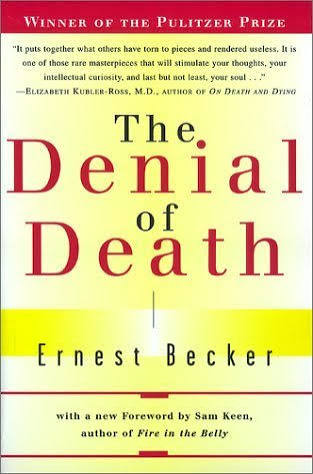
The Hardest Book I've Read
Not hard in the Shakespearean sense, where the words themselves are the barrier. Hard in a way that's harder to describe: the thoughts themselves forced me to think in ways I wasn't used to. I would read a passage, close the book, and just sit there. Minutes would pass. I'd pick it up again. Read another passage. Close it again. The book took weeks, not because it was long, but because it demanded recovery time between pages.
This is the only book I've ever given 10/10. I don't say that lightly.
The Core Thesis
Becker's argument is deceptively simple. Freud was wrong about what we repress. It's not sex. It's death.
Humans are unique among animals. We know we're going to die. We carry this knowledge with us every day, and it is absolutely terrifying. So terrifying that we build elaborate psychological structures to deny it. We create culture, religion, art, legacies, children all to convince ourselves that we won't truly disappear. We seek heroism in all its forms because heroes transcend death.
The Terror
One passage stopped me cold: "This is the terror: to have emerged from nothing, to have a name, consciousness of self, deep inner feelings, an excruciating inner yearning for life and self-expression and with all this yet to die."
Another, bleaker still: "Man... has no doubts; there is nothing you can say to sway him, to give him hope or trust. He is a miserable animal whose body decays, who will die, who will pass into dust and oblivion, disappear not only forever in this world but in all possible dimensions of the universe, whose life serves no conceivable purpose, who may as well not have been born."
That's the book. No comfort. No escape. Just the truth, stated plainly, and you have to sit with it.
What Works
The Framework
Once you see the world through Becker's lens, you can't unsee it. Everything becomes visible as death denial. The politician clinging to power. The artist seeking immortality through work. The parent investing everything in children. The wars we fight. The gods we worship. The fortunes we build. All of it, at root, a response to the same unbearable knowledge: we die, and we know it.
The Heroism Concept
Becker argues that human culture is essentially a heroism project. We need to feel that our lives matter, that we count for something in the cosmic scheme. This need drives everything from the noblest art to the cruelest tyranny. The terrorist and the saint are both responding to the same terror. They just chose different forms of heroism.
The Writing
For a book this dense, it's surprisingly readable. Becker synthesizes Freud, Jung, Rank, Kierkegaard, and others, but he writes with clarity and urgency. He was dying when he wrote this. You can feel it. There's no time for academic games. He's trying to say something true before he runs out.
What Doesn't
The Psychoanalytic Framework
Becker builds on Freud and his contemporaries, and this is the book's weakest layer. If you don't buy into psychoanalysis, large sections will feel like appeals to authority rather than arguments. One reader put it well: "If you don't like or don't understand psychoanalysis, don't read this book. If you have a love/hate relationship with it, this book will show you more of psychoanalysis's insight and explanatory powers, and its absurdities."
The Repetition
The book circles the same ideas repeatedly. Some readers find this reinforcing. Others find it tedious. I landed somewhere in the middle. Some chapters could have been half as long. But the core insights survived the repetition.
The Problematic Passages
A chapter on "perversions" hasn't aged well. Becker discusses homosexuality in terms that read as dated at best, offensive at worst. It's a reminder that the book is a product of its time, and some of its time hasn't traveled well. You have to read past it.
The 25/50/25 Rule
A reader captured the experience perfectly: about 25% of this book is completely outdated and useless, 50% is just boring, and the remaining 25% is so incredibly profound that your entire worldview shifts. That ratio held for me. I don't know if that's a recommendation or a warning. It's just the truth.
The Context
Becker won the Pulitzer for this book in 1974, awarded posthumously. He died of colon cancer at 49, less than a year after publication. He wrote it knowing he was dying. He gave a deathbed interview to a psychologist while the cancer consumed him. This isn't abstract theorizing. It's personal. He was staring at what he was describing.
A recent essay argued the book has never been more relevant. They traced modern phenomena Bryan Johnson's quest for immortality, the political gerontocracy's refusal to relinquish power, the authoritarian turn after COVID to unacknowledged death terror. A population traumatized by mass death, unable to process it, turning toward strongmen who promise certainty. Becker saw it coming fifty years ago.
Why 10/10
Because I've never read anything like it. Because months later, I'm still thinking about it. Because it changed how I see everything not in the shallow "this book changed my life" sense, but in the deeper sense that I can't look at human behavior without seeing the death denial underneath. The flaws are real. The dated sections are real. The repetition is real. None of it cancels the core.
The book offers no comfort. Becker doesn't pretend otherwise. His final suggestion a turn toward some kind of religious or transcendent perspective feels like a gesture rather than a solution. But that's honest. There are no solutions. There's just the truth, and learning to live with it.
Who Should Read It
Read it if you're willing to have your worldview dismantled. Read it if you're tired of shallow self-help and want something that takes human darkness seriously. Read it if you've ever stared at the ceiling at 3am and wondered what the point is.
Skip it if you need easy answers. Skip it if you're not ready to sit with discomfort. Skip it if you have no patience for psychoanalysis and its particular brand of dense, repetitive argument.
For everyone else: clear some time. Read it slowly. Put it down when you need to. Pick it up again when you're ready. It will still be there. It will always be there.
Final Verdict
10/10 - The only book I've ever given this rating. Flawed, dated, repetitive, and absolutely essential. It will change how you see everything, including yourself. Don't expect comfort. Expect truth.