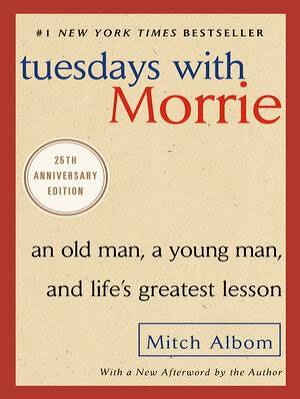
The Phenomenon
There's a strange thing that happens when a book becomes a phenomenon. You hear about it everywhere. People press it into your hands with that look, the one that says "this changed my life." By the time you actually read it, you're not just reading a book. You're reading against the weight of expectation.
Tuesdays with Morrie carries that weight. It has sat on bestseller lists for years. It has sold millions of copies. It has been translated into dozens of languages. People love this book. And I find myself wondering why.
What It Is
The setup is simple enough. Mitch Albom, a sports journalist consumed by his career, reconnects with his dying college professor, Morrie Schwartz. They meet every Tuesday. They talk about the big things: love, work, money, family, forgiveness, death. Morrie dispenses wisdom from his armchair while his body slowly gives out. The book is framed as a memoir, a tribute, a record of a teacher's final lessons.
It began as a series of television appearances with Ted Koppel, then became a newspaper column, then became this book. That origin matters. The book feels like what it is: a collection of moments stretched to fit between covers.
What's There
Morrie's situation is genuinely moving. A man facing his own death, choosing to spend his remaining months teaching, choosing openness over bitterness, that's not nothing. The physical details land: the failing body, the morning rituals that become impossible, the gradual retreat from independence. Albom records these with restraint, and they carry real weight.
Some of the conversations touch on things worth touching. The chapter on family has moments. The chapter on regret lands better than most. You can see why people connect with it.
What Isn't
The Philosophy
The philosophy is thin. Morrie's pronouncements, love wins, forgive yourself, money isn't everything, are not wrong. They're just not deep. They're the kind of thing people say when they want to sound wise without saying anything complicated. The book treats these as revelations, but they're closer to affirmations. There's no complexity, no tension, no sense that Morrie ever struggled with these ideas himself.
The Structure
The structure repeats relentlessly. Arrive at Morrie's. Talk about a topic. Morrie says something gentle. Albom reflects. Repeat. After a few chapters, the pattern becomes visible. After a few more, it becomes tiresome. The book doesn't build. It cycles.
The Narrator
Albom himself is a passive presence. He presents himself as a man so lost in career that he's forgotten how to feel. He's there to receive, not to question. This makes for a reading experience that feels less like conversation and more like lecture. You never get the sense that Morrie's ideas are being tested, pushed, examined. They're just received and recorded.
The Commercial Question
There's an irony that's hard to ignore. Morrie preaches against materialism. He warns about chasing money. He tells Albom that the culture of more is a trap. And Albom turned those conversations into a multi-million dollar empire. There's nothing wrong with a book selling well. But when the message is "money isn't important" and the medium is a product that made someone very rich, the dissonance sits there, unaddressed.
Who This Is For
This is an entry-level book for entry-level questions. If you haven't thought much about mortality, about meaning, about what matters, it will probably land. It did for me, once. It's emotional, sincere, and undemanding. You can read it in an afternoon and feel like you've done something good for yourself.
If you've done the work already, if you've sat with actual difficult questions instead of surface answers, you might find yourself underwhelmed. The book doesn't hold up to scrutiny. It's not meant to. It's meant to be felt, not thought about.
The Bestseller Question
The phenomenon remains strange to me. Millions of people have made this a bestseller. They've pressed it into hands, recommended it to friends, built their book clubs around it. I don't think they're wrong to be moved. I just think they're moved by something simpler than they realize.
The book works if you let it work on you without asking too many questions. Ask questions, and it starts to thin out. Maybe that's true of most things. Maybe that's the point.
Final Thoughts
I don't regret reading it. I'm not sure I'd recommend it. The 5/10 feels right: it did something for me at the time, but that something was mostly about where I was, not what the book actually contains. On the page, it's thin. In memory, it's complicated.
I won't be pressing it into anyone's hands.
Rating
5/10 - It exists. People love it. I don't quite get why.